Showing posts with label oysterman. Show all posts

Friday, January 11, 2013

Oyster Geek and Oyster Freak


Troy D. Alphin
Center for Marine Science - UNCW
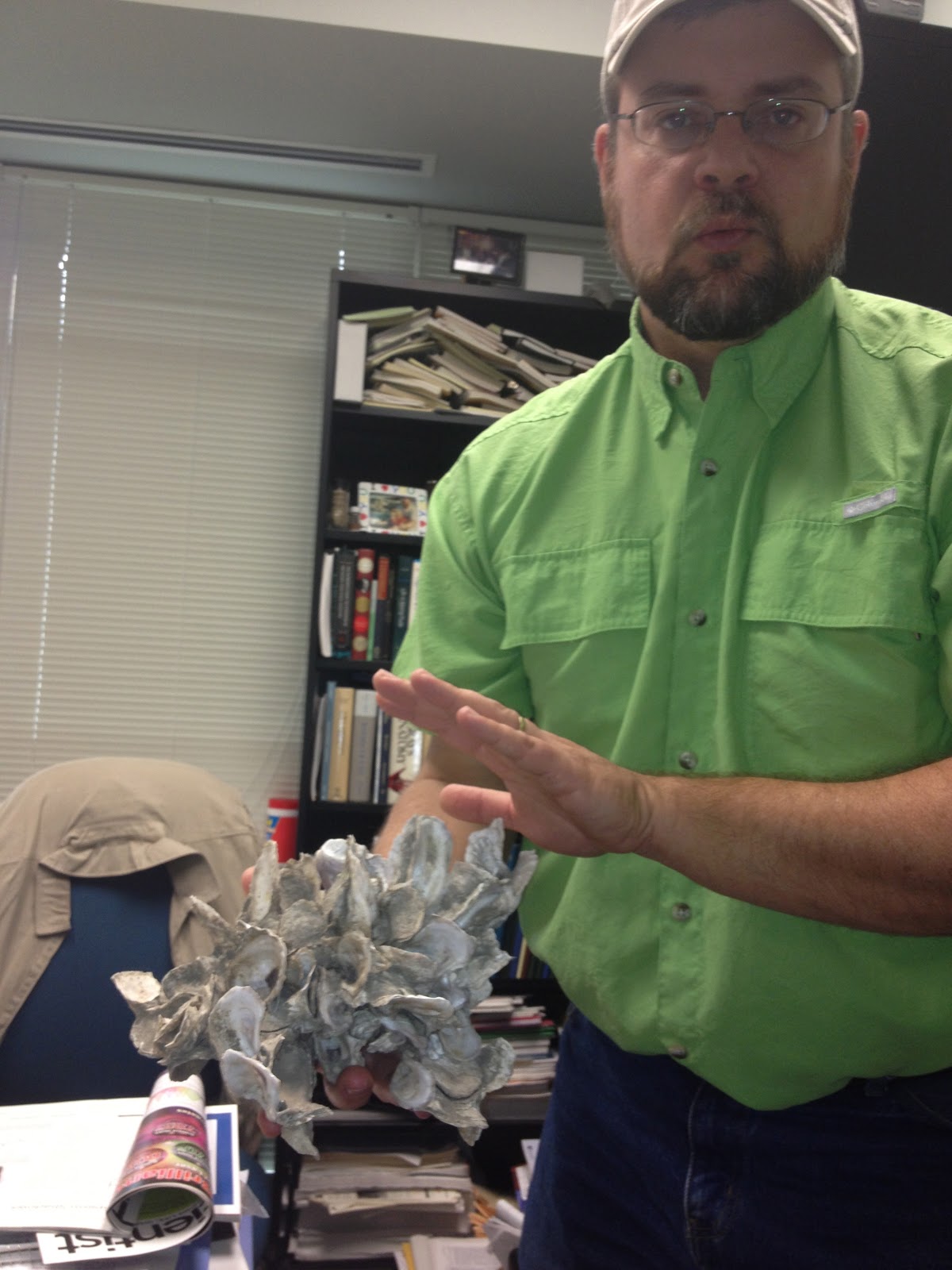
I'm an oyster geek.  There are few topics that interest me as much as oysters, which is why I was so excited to chat with Troy Alphin, Senior Research Associate at the Center for Marine Science at the University of North Carolina, Wilmington (UNCW).   He's an oyster geek-in-residence and talks about the lowly oyster with whimsy, admiration, passion, and, above all else, respect. With a bachelor's and master's degree in marine biology, Alphin is currently working on his doctorate in marine biology.  His doctoral project is trying to answer the question: What does a happy oyster look like?

"Think about it, if you go to a restaurant or grocery store or even see them in their natural habitat, how do you know they're happy?"

Did I mention that we were talking about the no face, no legs, no arms, no brain oyster? Happiness seems elusive.

He's still researching telltale signs to determine if an oyster is happy, but he is willing to give us some clues.  He calls them "ecosystem engineers" (fancy).  " Once established, they engineer the environment around them."  They attract mussels and oysters, trap nutrients, and filter the water.  They can even, in some regions, such as North Carolina, save us from storm surges.  Panda bears and kitty cats may get more attention, but none of them can do all that.  When the oyster is allowed to do their job, they are happy.

Even super studly, uber happy engineers, though, need a little help from us.

HELP SAVE THE OYSTER BABIES 

Millimeter comparison.
From http://waynesword.palomar.edu
"One of the biggest problems facing oysters today is the oyster larvae," Alphin says.  The oyster larvae is 1/10 of a millimeter.  To understand how small that is, try and touch your thumb and pointer finger as close together as possible without them touching.  Oyster larvae are 1/10 the distance between your thumb and finger.    Oyster larvae survival depends on their ability to connect to an existing structure, usually another oyster shell. However, sediment from runoff settles on the oyster shells.  The sediment is 1/2 mm, five times the size of a larvae, which makes it incredibly difficult for the larvae to find its own spot on a shell.  If the larvae can't find a place to nestle onto the shell, they will die.

That's where we come in.  We all have to do our part to help alleviate storm water runoff.  If you're lucky enough to live on a creek or estuary, make sure to leave the edge of your property in it's natural state.  Minimize or alleviate chemicals both inside your home and out.  And don't discharge anything directly into the water.

DYING YOUNG

Freak of Nature?
Fossilized oyster shell is at least
a foot long and probably
35 million years old.
Even those oysters who find a spot to grow face limited prospects.  We've come to accept that oysters live 4-5 years on the East Coast and grow to about 3-4 inches.  But just 100 years ago, oysters harvested from the waters outside New York were 6-8 inches.  Today, even in protected areas, oysters aren't living long past their cousins in open, harvested waters.  "Why?" he asks.  "There's no programmed death for oysters.  It's got to be the environment.  It's got to be ecological."

Why is it important that oysters live longer?  The longer the oyster lives, the bigger the oyster grows.  The bigger the oyster grows, the more eggs a female can produce.  The more eggs they produce, the more larvae.  The more larvae, the greater number of oysters.

PEARLS OF WISDOM

Because Alphin is both a biologist and oyster eater, I thought he was the perfect person to ask the two most important questions that nag oyster aficiandos:

1. Do you eat raw oysters? 
"You should always cook your oysters," he says.

2. Do you eat (non-triploid) oysters in non-R months?
"Yes, as long as they're cultivated.  And they're cooked."

And that's all he'll say about that.  I, however, remain loyal to raw oysters.  And that's all I'll say about that.

Thanks for working every day to help save the oyster, Troy.


Tuesday, September 25, 2012

Day Out with a Carolina Oyster Farmer


Ronald Sheffield
Owner Topsail Sound Shellfish
Just to prove that ostreophiles live among us, it turns out that my health insurance broker is also a budding oysterman.  Ronald Sheffield is the owner of Topsail Sound Shellfish, a boutique oyster farm on the Southeast coast of North Carolina.  I asked really nice - borderline stalked him by phone - and he agreed to take me out to see how he nutures his oysters.


5-acre aqua farm in the Intracoastal Waterway

Several times a week, Sheffield heads out on his Carolina Skiff to see how his oysters (and clams) are doing.  Last Wednesday, I was lucky enough to go with him to his 5-acre aqua farm in an estuary off the Intracoastal Waterway that he leases from the state of North Carolina.  Because I don't have an oysterman's license, I wasn't allowed to touch a thing (bummer!) but I did get to watch and take pictures.  Can you see the lines of floating bags?  Each bag contains hundreds of oysters growing safe and sound in water with very high salinity.  Unlike in the northeast where the bags are sometimes frozen under the ice, the mild North Carolina climate means no freezing and year-round access to the oysters.


Oyster seeds: crossbreed bxblyn.9


Sheffield starts with oyster seeds - not spat - no bigger than 1mm.


Sheffield loading the nursery bags 
into the floating bags.


He places thousands of the seeds into small mesh nursery bags and then places the nursery bags into the floating bags.


Oysters about to be moved from the nursery.
Compare to market-size oysters.


A couple months later he checks the bags to see which ones can be moved out of the nursery and directly into the floating bags.


Sifting young oysters.


In the early stages, he empties each bag into a colander and then hand sifts through the growing oysters.   The toddler oysters are then placed into the floating bags to continue growing. I can't express enough how tedious this part of the process is.   It was while watching him sift through these tiny oysters that I truly appreciated the love and effort that goes into my beloved bivalves.


Checking the floating bags


Every couple of months he checks on the growing oysters, separates them again and moves them to new bags by size.


Full-grown oysters ready for market
Tick tock.  Tick Tock.

 Finally, 15-17 months later - after checking and rechecking the oysters, cleaning out debris, flipping the bags over and over to prevent barnacles - the oysters are finally ready for market.  The triploid Topsail Sound Salties - as Ronald has named them - have a brine around 35 ppm - yum!  


Topsail Sound Salties
Shucked and ready to eat

When he took me back to the dock, he popped open a Topsail Sound Salties.  Fresh out of the water and loaded with brine and seawater, the oyster exploded my senses.  These are not starter oysters.  They are large, briny, hit-you-over-the head oysters that taste like the ocean and could stand up to to a Zinfendel or oaky Chardonney. 


Interested in Topsail Sound Salties?  Contact Ronald at topsailsoundshellfish@gmail.com.  He sells out every time he harvests so you may have to get on his waiting list.  

Thanks Ronald for a wonderful day!