Showing posts with label oyster farming. Show all posts

Wednesday, February 6, 2013

Save the Spat


For some, counting oyster spat is right up there with watching golf on TV.  But for the group of dedicated volunteers with the Oyster Spat Monitoring Project, it's like Sunday at the Master's (or close enough).  The Oyster Spat Monitoring Project tries to determine how many offspring an oyster can produce (an important but difficult number to determine) and how many of those offspring survive.  It's easy with land animals, or egg-laying reptiles and birds.  But measuring oyster larvae - also called spat - is a bit more tricky.  It's thought that a female oyster could lay up to 100 million eggs annually.  But pinpointing that number regionally and by species is like looking for a needle in the proverbial hay stack.

The Oyster Spat Monitoring Project

How many of the millions of spat survive long enough to attach to a structure and finally grow into a harvestable oyster?  At the risk of throwing out another bad idiom, I'll turn to our friend at Oyster Stew and marine biologist Troy Alphin.  (Click here to read a previous post about him.)  He developed this program to actually count spat - casting a wide net over the state of North Carolina to account for the long distances larvae can travel before attaching to a host.  His method, along with gritty determination to keep the program alive, is the backbone of this organization.


The Oyster Spat Monitoring Project is an all-volunteer effort coordinated by the Benthic Ecology Lab at the University of North Carolina, Wilmington (UNCW).  Currently, 35 active volunteers meticulously count spat, collected on Spat Racks, up and down the North Carolina coast.  Volunteers are given a packet of recording supplies and a "Spat Rack." After training for a few hours with scientists at UNCW, all volunteers need to participate in the program is a couple of free hours a month (depending on the time of year) and legal access to a dock.   

Oyster Spat Monitoring volunteers receive
a "Spat Rack," (see picture below) a field journal, pencils,
reference guides, and a thermometer.

Volunteers are asked to place the Spat Rack on top of the mud or sand in the mid-intertidal line and attach the Spat Rack to their dock.  If placed in the correct position, the racks should be exposed to air during low tide and submerged during high tide.

"Spat Rack"
Made from PVC pipe, ceramic tiles, cable tiles and a drain hose.
(Image taken by former volunteer coordinator Heather Stoker)

Oyster larvae are able to survive without a host - something to attach to - for about two weeks.  If they don't find something to attach to during those two weeks, they will die.  Desperation often leads to inspiration, which explains why if an oyster can't find another oyster shell to call home, they will attach to just about anything.  

Oysters attach to ceramic tiles on the "Spat Rack."
(Image taken by volunteer Preston Somers.)
The Oyster Spat Monitoring Project uses ceramic tiles to make it easier to count the oysters and is a good substitute for oyster shells.   Every six weeks, the volunteers count the live baby oysters that have attached themselves to the structure and record their findings.  They are also asked to identify and record other organisms, such as slipper shells, mussels and snails, that settle on the ceramic tiles.  Volunteers also collect environmental information such as air and water temperature, water salinity and weather conditions.
What have they learned from this project so far?  I'll let Troy Alphin explain:

"Over the last few years we have found that oyster larvae remain in the water column in the southern area (from White Oak River and areas south) longer than in the central and northern regions of the coast.  So it is not uncommon to get oyster settlement in Nov.  Also, oysters respond to dramatic changes in the weather so that we sometimes see a pulse of larval settlement following coast storms in the late fall."

Smarty pants ... Thanks again Troy!


 The Oyster Spat Monitoring Project is always looking for more volunteers to keep an accurate count of the oyster larvae in your area.  If you live in North Carolina, have a couple of hours a month, and have legal access to a dock, contact Megan Rudolf at rudolfm@uncw.edu.  To donate to the program, please contact Troy Alphin at alphint@uncw.edu. For more information, visit www.ncoystermonitoring.org.  And, if saving the oysters isn't incentive enough, check out the thank you gift each volunteer received at Christmas last year ... 

Troy Alphin and his family hand-painted
oyster shells to make Christmas ornaments
for all the Oyster Spat Monitoring Project volunteers.  


Thursday, January 24, 2013

Island Creek Oyster Bar. WOW!

Island Creek Oyster Bar has been on my oyster bucket list for a while so I was thrilled when I finally got the chance last week to stop by for a visit.  Wow, wow, wow!

Island Creek Oyster Bar
Boston, MA
Island Creek Oyster Bar is beyond good.   In fact, the restaurant would be a little intimidating if the staff weren't so friendly, the menu so approachable and the atmosphere so cozy.  The chef is pretty cool too.  It's all part of the secret sauce that has made this a hotspot for oyster newbies and ostreaphiles alike.

Jeremy Sewall, chef and co-owner
Island Creek Oyster Bar

I sat down with Jeremy Sewall, the chef and co-owner of Island Creek Oyster Bar, to talk oysters.  It turns out he's a quiet champion of the bivalve, intent on elevating and innovating the oyster experience.  He's inventing modern recipes, preaching the importance of knowing the oyster growers, introducing Northeasterners to impossible-to-get oysters, and stretching the palettes of his diners.

Sewall opened Island Creek Oyster Bar with acclaimed Island Creek Oysters owner/farmer Skip Bennett and restaurateur Garrett Harker in 2010.  The trio are heavy hitters on the Boston food scene.  In a line of many firsts, Sewall was the first chef to visit the Island Creek Oyster farm when he was searching for oysters to serve at Lineage, the restaurant he owns with his wife, Lisa.


What's the fascination with oysters?

He says he "riding the wave" of the oyster's growing fan base.  Cultivated oysters are sustainable and they're carbon negative, he says.  "And there's tons of health benefits." Oysters are high in zinc, are packed with high quality protein, and are a natural source of Vitamin D.  (I'll blog soon about all the health benefits from eating oysters.)

Located just a stone's throw away from Fenway Park in downtown Boston, Island Creek Oyster Bar has quickly become a favorite pre- and post-game spot for Red Sox fans. "Oysters, beer and baseball," he grins.  "Come on."  A perfect combo.

Raw bar at Island Creek Oyster Bar
The restaurant offers 8 - 12 varieties a night


The raw bar features 8 - 12 varieties of oysters per night.  Island Creeks are a staple, as are locally cultivated oysters from New England.  "It's not uncommon for people to eat through the list," he says.  The list of available oysters is updated online every night by 5pm.  Check out the available selections and the rest of the menu.


Another Sewall first: Island Creek Oyster Bar is the first and only East Coast restaurant that serves the infamous Hog Island Oysters.  (Visiting Hog Island Oyster farm is another entry on my bucket list).  The restaurant receives a bag of Hog Islands a week and when they're gone, they're gone.  Sadly, they were gone when I visited, but Sewall did treat me to a half dozen local oysters.

Ichabod Flat from Plymouth, MA
Island Creeks
Chef's choice: Island Creeks, Beach Points, Chathams, Rocky Nooks, Ichabod Flats and wild Wellfleets.  I'll write more about them in a future blog, but the quick take away is Yum!  My favorite was the Island Creek, but a close second was the Ichabod Flats from Plymouth, MA.    Both have an elevated briny flavor that I prefer.  I also enjoyed the wild Wellfleet, which were lettucey, a nod to their cousins on the West Coast.

Which one does Sewall prefer?

"Island Creeks, of course!"

The Ichabod Flats also happen to be Sewall's favorite at the moment.  That's the thing about oysters, you always get to try new ones and choose a new favorite.


Oysters Gregory
Recipe by Jeremy Sewall and Shore Gregory
Sewall's favorite oyster recipe?

 Oysters Gregory.  It's a dish he created and it boasts a following online.  Freshly shucked Island Creek Oysters sit on a a bed of creamed leaks topped with garlic, bacon, panko breadcrumbs, lemon zest and paprika.  They are then baked and served hot.  I tracked down the recipe for you thanks to the foodies at how2heros.com.  You can watch a video of Sewall himself making the dish he loves.

So now I cross off another item from my bucket list.  I think I've found my new favorite oyster bar.  Thanks for the oysters Chef Jeremy!


Island Creek Oyster Bar
500 Commonwealth Ave.
Boston, MA  02215
p. 617-532-5300


Friday, January 11, 2013

Oyster Geek and Oyster Freak


Troy D. Alphin
Center for Marine Science - UNCW
I'm an oyster geek.  There are few topics that interest me as much as oysters, which is why I was so excited to chat with Troy Alphin, Senior Research Associate at the Center for Marine Science at the University of North Carolina, Wilmington (UNCW).   He's an oyster geek-in-residence and talks about the lowly oyster with whimsy, admiration, passion, and, above all else, respect. With a bachelor's and master's degree in marine biology, Alphin is currently working on his doctorate in marine biology.  His doctoral project is trying to answer the question: What does a happy oyster look like?

"Think about it, if you go to a restaurant or grocery store or even see them in their natural habitat, how do you know they're happy?"

Did I mention that we were talking about the no face, no legs, no arms, no brain oyster? Happiness seems elusive.

He's still researching telltale signs to determine if an oyster is happy, but he is willing to give us some clues.  He calls them "ecosystem engineers" (fancy).  " Once established, they engineer the environment around them."  They attract mussels and oysters, trap nutrients, and filter the water.  They can even, in some regions, such as North Carolina, save us from storm surges.  Panda bears and kitty cats may get more attention, but none of them can do all that.  When the oyster is allowed to do their job, they are happy.

Even super studly, uber happy engineers, though, need a little help from us.

HELP SAVE THE OYSTER BABIES 

Millimeter comparison.
From http://waynesword.palomar.edu
"One of the biggest problems facing oysters today is the oyster larvae," Alphin says.  The oyster larvae is 1/10 of a millimeter.  To understand how small that is, try and touch your thumb and pointer finger as close together as possible without them touching.  Oyster larvae are 1/10 the distance between your thumb and finger.    Oyster larvae survival depends on their ability to connect to an existing structure, usually another oyster shell. However, sediment from runoff settles on the oyster shells.  The sediment is 1/2 mm, five times the size of a larvae, which makes it incredibly difficult for the larvae to find its own spot on a shell.  If the larvae can't find a place to nestle onto the shell, they will die.

That's where we come in.  We all have to do our part to help alleviate storm water runoff.  If you're lucky enough to live on a creek or estuary, make sure to leave the edge of your property in it's natural state.  Minimize or alleviate chemicals both inside your home and out.  And don't discharge anything directly into the water.

DYING YOUNG

Freak of Nature?
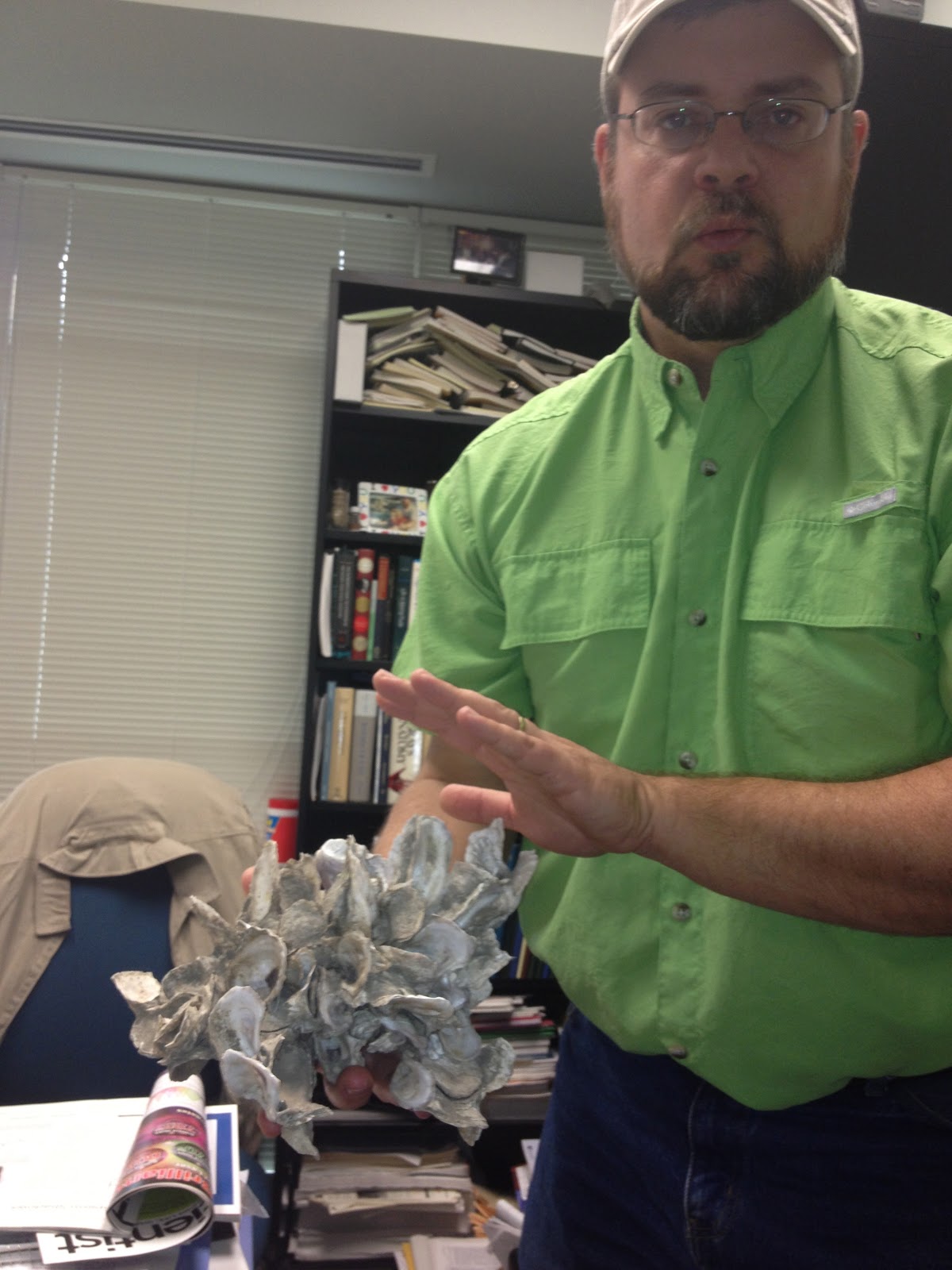
Fossilized oyster shell is at least
a foot long and probably
35 million years old.
Even those oysters who find a spot to grow face limited prospects.  We've come to accept that oysters live 4-5 years on the East Coast and grow to about 3-4 inches.  But just 100 years ago, oysters harvested from the waters outside New York were 6-8 inches.  Today, even in protected areas, oysters aren't living long past their cousins in open, harvested waters.  "Why?" he asks.  "There's no programmed death for oysters.  It's got to be the environment.  It's got to be ecological."

Why is it important that oysters live longer?  The longer the oyster lives, the bigger the oyster grows.  The bigger the oyster grows, the more eggs a female can produce.  The more eggs they produce, the more larvae.  The more larvae, the greater number of oysters.

PEARLS OF WISDOM

Because Alphin is both a biologist and oyster eater, I thought he was the perfect person to ask the two most important questions that nag oyster aficiandos:

1. Do you eat raw oysters? 
"You should always cook your oysters," he says.

2. Do you eat (non-triploid) oysters in non-R months?
"Yes, as long as they're cultivated.  And they're cooked."

And that's all he'll say about that.  I, however, remain loyal to raw oysters.  And that's all I'll say about that.

Thanks for working every day to help save the oyster, Troy.


Tuesday, September 25, 2012

Day Out with a Carolina Oyster Farmer


Ronald Sheffield
Owner Topsail Sound Shellfish
Just to prove that ostreophiles live among us, it turns out that my health insurance broker is also a budding oysterman.  Ronald Sheffield is the owner of Topsail Sound Shellfish, a boutique oyster farm on the Southeast coast of North Carolina.  I asked really nice - borderline stalked him by phone - and he agreed to take me out to see how he nutures his oysters.


5-acre aqua farm in the Intracoastal Waterway

Several times a week, Sheffield heads out on his Carolina Skiff to see how his oysters (and clams) are doing.  Last Wednesday, I was lucky enough to go with him to his 5-acre aqua farm in an estuary off the Intracoastal Waterway that he leases from the state of North Carolina.  Because I don't have an oysterman's license, I wasn't allowed to touch a thing (bummer!) but I did get to watch and take pictures.  Can you see the lines of floating bags?  Each bag contains hundreds of oysters growing safe and sound in water with very high salinity.  Unlike in the northeast where the bags are sometimes frozen under the ice, the mild North Carolina climate means no freezing and year-round access to the oysters.


Oyster seeds: crossbreed bxblyn.9


Sheffield starts with oyster seeds - not spat - no bigger than 1mm.


Sheffield loading the nursery bags 
into the floating bags.


He places thousands of the seeds into small mesh nursery bags and then places the nursery bags into the floating bags.


Oysters about to be moved from the nursery.
Compare to market-size oysters.


A couple months later he checks the bags to see which ones can be moved out of the nursery and directly into the floating bags.


Sifting young oysters.


In the early stages, he empties each bag into a colander and then hand sifts through the growing oysters.   The toddler oysters are then placed into the floating bags to continue growing. I can't express enough how tedious this part of the process is.   It was while watching him sift through these tiny oysters that I truly appreciated the love and effort that goes into my beloved bivalves.


Checking the floating bags


Every couple of months he checks on the growing oysters, separates them again and moves them to new bags by size.


Full-grown oysters ready for market
Tick tock.  Tick Tock.

 Finally, 15-17 months later - after checking and rechecking the oysters, cleaning out debris, flipping the bags over and over to prevent barnacles - the oysters are finally ready for market.  The triploid Topsail Sound Salties - as Ronald has named them - have a brine around 35 ppm - yum!  


Topsail Sound Salties
Shucked and ready to eat

When he took me back to the dock, he popped open a Topsail Sound Salties.  Fresh out of the water and loaded with brine and seawater, the oyster exploded my senses.  These are not starter oysters.  They are large, briny, hit-you-over-the head oysters that taste like the ocean and could stand up to to a Zinfendel or oaky Chardonney. 


Interested in Topsail Sound Salties?  Contact Ronald at topsailsoundshellfish@gmail.com.  He sells out every time he harvests so you may have to get on his waiting list.  

Thanks Ronald for a wonderful day!